In the past three years, the number of dedicated professional women’s volleyball leagues in the United States went from zero to two. Before 2024, it wasn’t easy for American fans to watch their favorite NCAA volleyball alumni in action, as the only viable playing careers for these athletes involved moving abroad. The very best players typically ended up in Italy or Turkey; others found success elsewhere in Europe, like Germany and Poland, while others still made new homes in South America or East Asia.
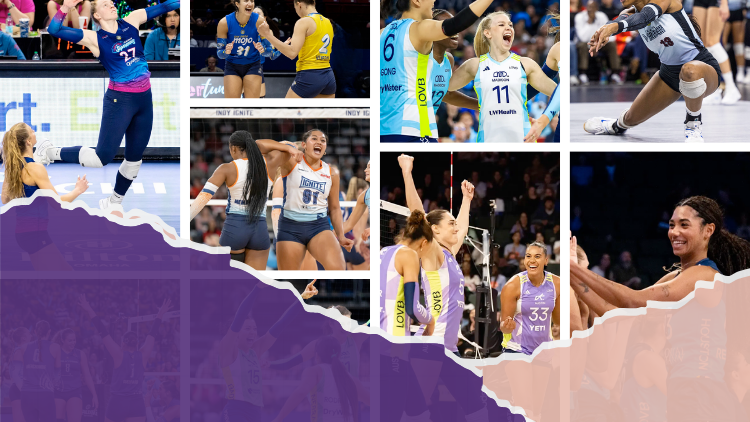
But things have changed: with the launch of Major League Volleyball (MLV, formerly known as the Pro Volleyball Federation) and League One Volleyball (LOVB, pronounced “love”), there’s never been a better time to be a women’s volleyball fan in the United States.
With the existence of two leagues, of course, comes the inevitable comparisons. If you’re in any online volleyball spaces, you’ve undoubtedly seen discussion and debate around which league is better. But for me—an avid fan of both volleyball and spreadsheets—the two leagues represent not an opportunity to yell at people on Reddit, but rather to make lots and lots of charts.
So, I’ve spent a few days diving into the data. I collected information including age, height, years of experience, and participation in international tournaments for each of the 223 athletes between the two leagues. Here’s what I found.
The Major Differences Between Players in LOVB vs. MLV
The general consensus from online discussions about the two leagues is that LOVB has the higher level of play due to the presence of more seasoned athletes (including quite a few Olympians) on its six squads. Meanwhile, MLV is considered more of a launching point for younger players who are in the beginning stages of their careers.
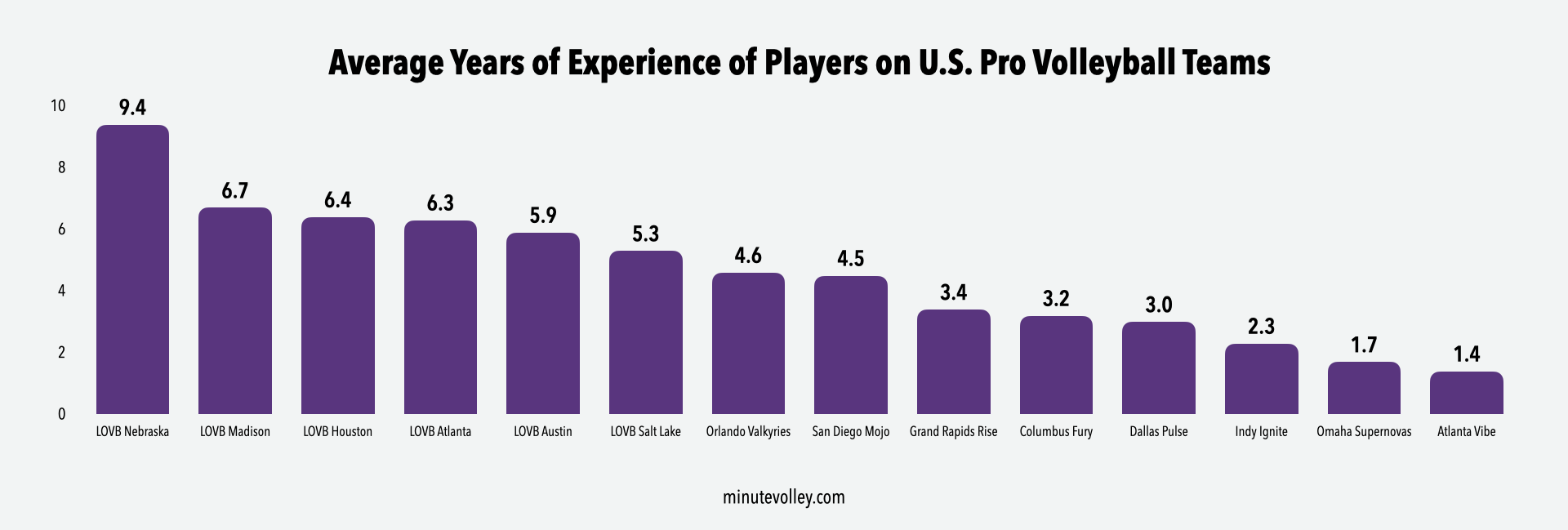
The data that I looked at very much supports these narratives: across all LOVB players, the average number of years of experience is 6.7 compared to MLV’s 3.1. This is partially driven by a large difference in the number of rookies in each league; in LOVB, there are ten players taking part in their first-ever professional season, whereas MLV is home to 25 first-year pros. When looking at players with five or more years of experience, LOVB has 55 such players, just about double MLV’s 28.
Perhaps even more telling is that the Orlando Valkyries, the MLV team with the highest average years of experience at 4.6, has a lower average than LOVB Salt Lake, the LOVB team with the fewest average years of experience at 5.3.
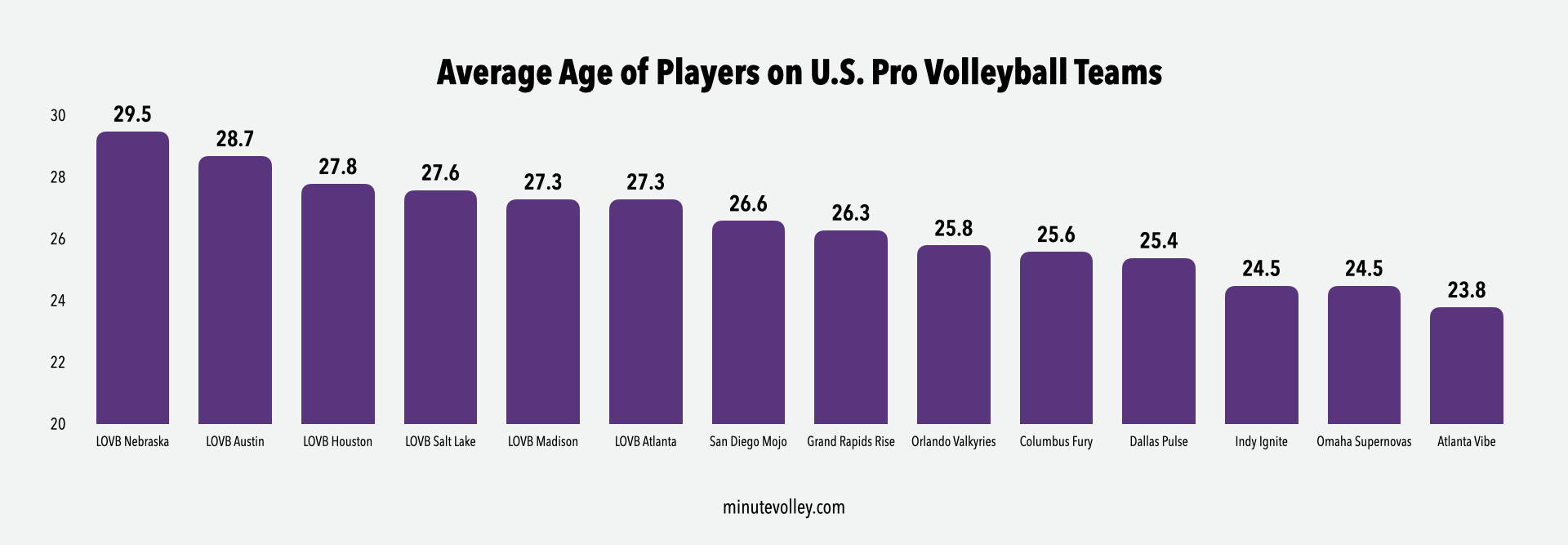
Unsurprisingly, the data about players’ ages shakes out similarly. The average age of players across both leagues is 26.5, but LOVB players skew slightly older at 27.5, while MLV players average 25.3. Again, the oldest MLV team—this time the San Diego Mojo, with an average age of 26.5—is younger than the youngest LOVB team which is a tie between LOVB Atlanta and LOVB Madison, both of which have an average age of 27.3.
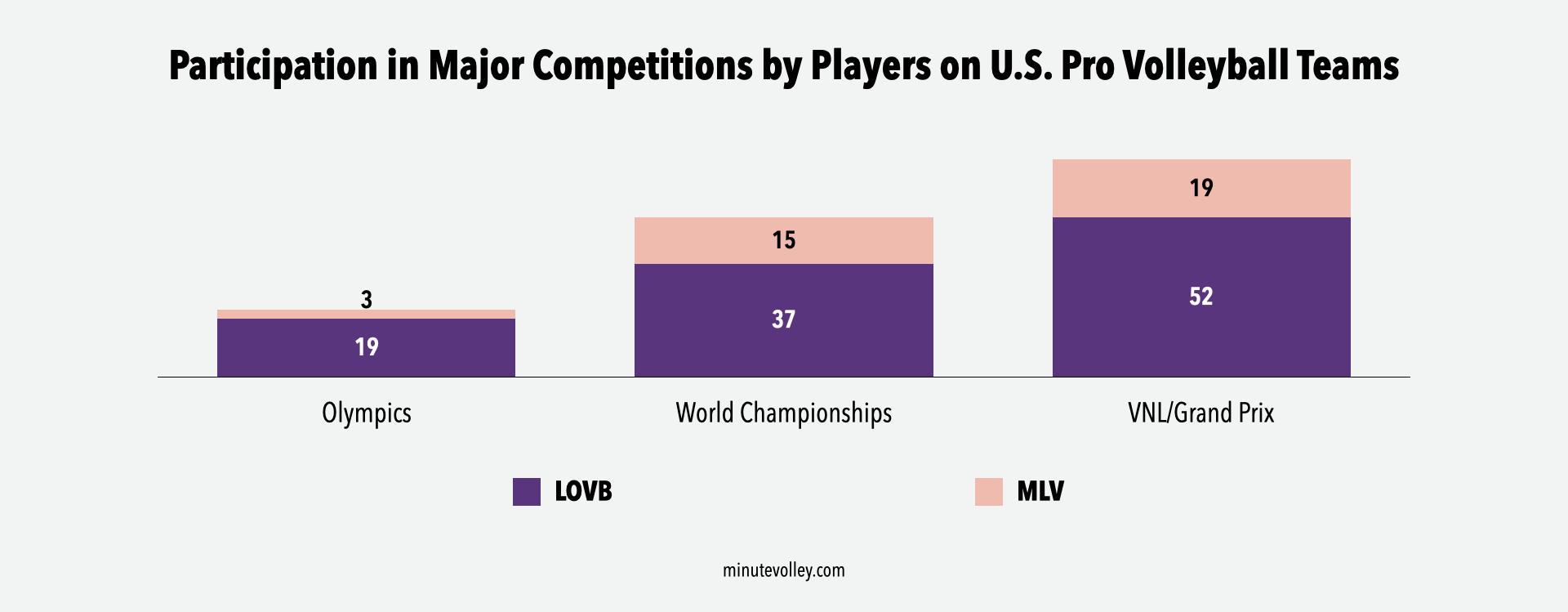
As alluded to earlier, LOVB also overwhelmingly has more players who have represented their country at the highest level. In terms of Olympians, LOVB outnumbers MLV 19 to three. Of LOVB’s 19, eight of those players have won an Olympic gold medal and an additional four have won silver or bronze. Only one of MLV’s three Olympians has a medal from the event: 37-year-old Jovana Brakocevic, who won a silver medal with Serbia in 2016.
As for the other two competitions I looked at, 36 LOVB players have played in the World Championships and 52 have played at the VNL (or its predecessor, the World Grand Prix). MLV has 15 World Championship participants and 19 VNL alumni. Unsurprisingly, there is a lot of overlap in terms of players who have participated in these three events (i.e., if a player has gone to the Olympics, chances are high that they’ve also been to the World Championships and VNL).
What MLV and LOVB Have in Common
It’s easy to focus on the differences between the leagues, but I also wanted to see where they proved to be more similar. Given the varying levels of “prestige” between the leagues, you might think that LOVB has the more physically dominant players, but the data surrounding height shows this isn’t the case. The average height of players is the same across both leagues: 184.3 centimeters, which is somewhere in the vicinity of 6’0” to 6’1”. When excluding liberos, the average height is ever so slightly different: 187 cm for LOVB and 186.7 cm for MLV—both of which are just under 6’2”.
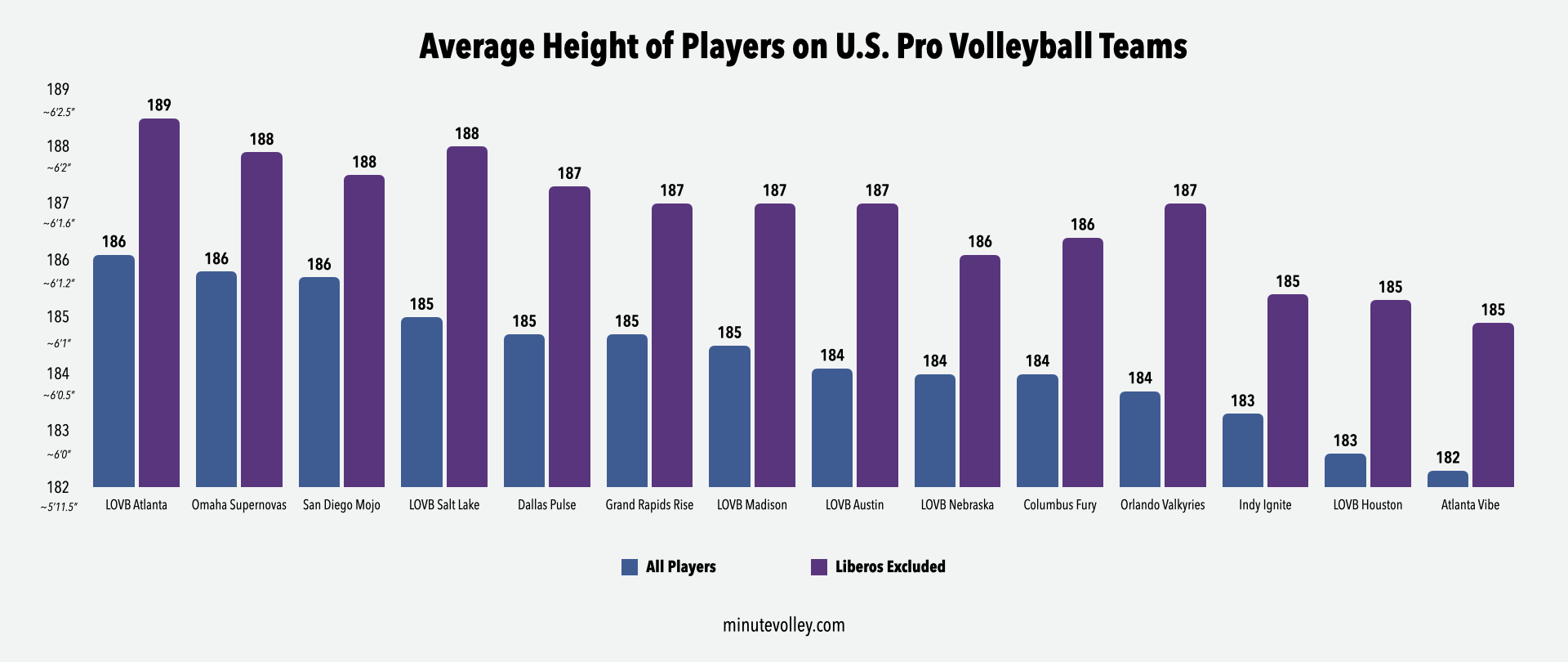
The biggest height disparity is between opposites; those in LOVB average out to 190 cm (just under 6’3”), which is 1.8 cm more than the average heightt of an opposite in MLV. While LOVB tends to lead in terms of height among positions, both MLV’s middle blockers and liberos are on average taller by 1.5 and 0.5 cm respectively.
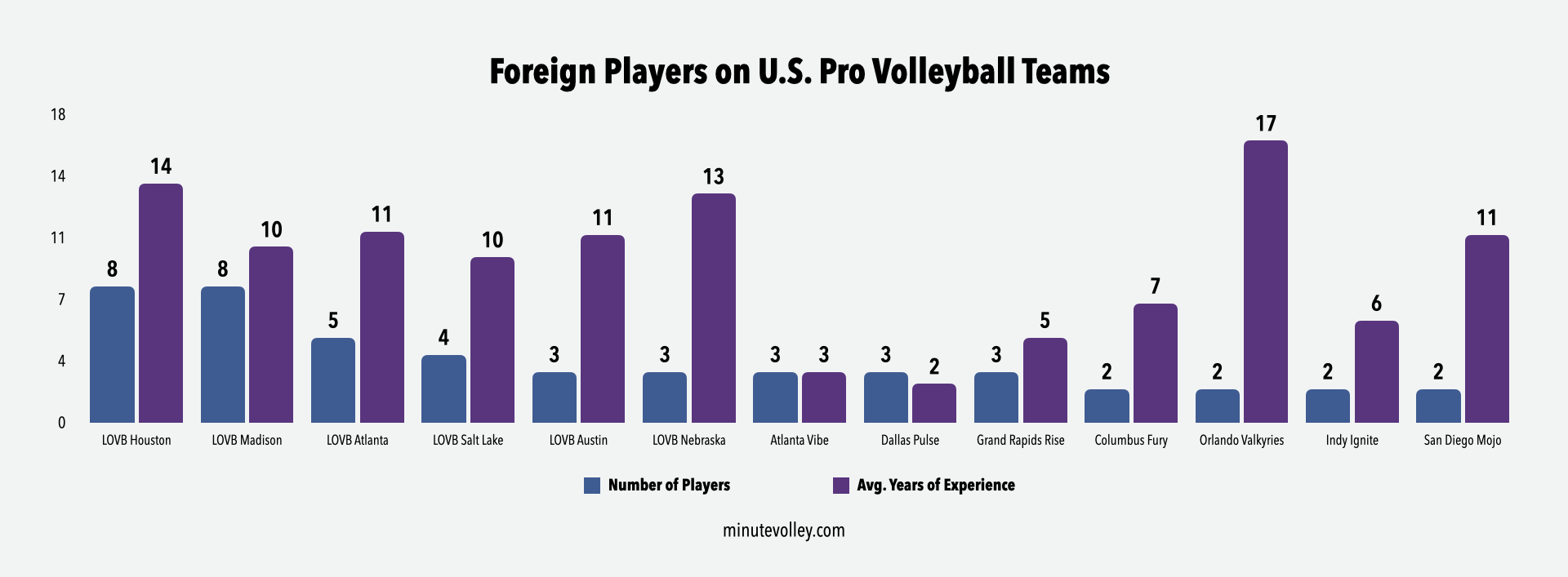
Another shared trait of the leagues is their approach to signing international players. As a result of league-imposed limits on how many foreign players can be on a roster (up to three), MLV only has 20 foreign players, making up 16% of its athletes. These limits don’t exist in LOVB, where 31 (32%) players are foreign. Two of LOVB’s squads, Nebraska and Madison, each have eight foreign players signed.
While 68% vs. 86% of players being American is a pretty big difference, the strategy for having these players in each league seems to be the same: adding seasoned pros. On average, LOVB’s foreign players have played professionally for 11.7 years compared with just 4.3 years for its American players. The difference is slightly less stark but still present in MLV, whose foreign players average 6.6 years of experience compared to American players’ 2.5.
Both leagues rely most heavily on foreign outsides: nine of LOVB’s outsides and seven of MLV’s are from outside the U.S. The leagues both rely the least on foreign setters, with LOVB having four and MLV having only one setter from outside the states.
The last commonality between the leagues that I noticed is the presence of NCAA alumni. This isn’t terribly surprising, given that the American volleyball player’s path to playing professionally almost always involves participating in the NCAA. 76% of LOVB players and 94% of MLV players have spent at least one season playing in the NCAA, making for an overall total of 86% of players across each league. This includes NCAA participation by seven of LOVB’s 31 foreign players (23%) and 10 of MLV’s 17 (59%).
What To Make (and What Not to Make) of All This
The internet doesn’t always get it right (that might be a gross understatement, in fact), but when it comes to the major differences between MLV and LOVB, online volleyball fans are mostly right on the money: LOVB is the league with more seasoned pros, while MLV is a springboard for younger talent. If you were hoping for some grand twist that would reveal it is in fact MLV that has the higher caliber of talent, or LOVB that focuses more on developing players straight out of college, then I am sorry to disappoint you.
But of course, this ultimately doesn’t have to mean anything as far as individual enjoyment of the leagues. While I’ve been Online™ long enough to know that there are people out there who won’t be satisfied unless they can somehow definitively prove that their preferred league is objectively better, my hope is that the majority of fans simply make up their own minds and do what makes the most sense for them. If you’ve started watching NCAA volleyball in the past few years and are mostly interested in keeping up with recent grads, then MLV is likely the better league for you. If you’re a long-time watcher of the sport and want the opportunity to see the nation’s best players play at home, then LOVB is more your speed. But if you, like me, are simply obsessed with volleyball and can’t get enough of it, then your only choice to make is which match to watch when there are multiple airing at the same time.
Notes on Data Collection
- Player name, team, and position: Pretty straightforward here - I took this data from each team’s website roster.
- Years of professional experience: Being the sicko that I am, I have a pretty strong recollection of which players are rookies or have one-to-two years of pro experience. In those cases, I filled this in from memory. For the rest, I used Volleybox to see the number of clubs and the associated years playing for those clubs that each player has on their profile. While it’s not a source I would recommend using for your academic papers, when it comes to the accuracy of information about volleyball players, I trust the volunteers at Volleybox with my life.
- Height: Again, straightforward - this comes straight from official rosters. However, I did estimate the height in centimeters of each player based on what I like to call their “American height.” For example, for players listed at 6’0”, I added a column to indicate their height in centimeters as being 183. Is it possible that someone listed at 6’0” is in fact 184 or 182 centimeters tall? Sure, but I’m not terribly concerned with being off by a centimeter or two.
- Age: For the vast majority of players, I was able to find their date of birth either via Wikipedia or Volleybox. For those whose birthdays are not present on either source, I did some Googling. Shoutout to any volleyball player who has posted on Instagram to celebrate their birthday and specified what age they are turning, as this helped enormously to fill in gaps. For the handful of players who were not compelled to celebrate turning 21 on Instagram, I made an educated guess based on when they graduated college.
- International tournament participation: For each player, I noted if they have ever represented their nation at the Olympics, World Championships, or Volleyball Nations League/World Grand Prix. I chose these three events as they are the highest level of international competition in the sport, and therefore the most selective in terms of rosters.