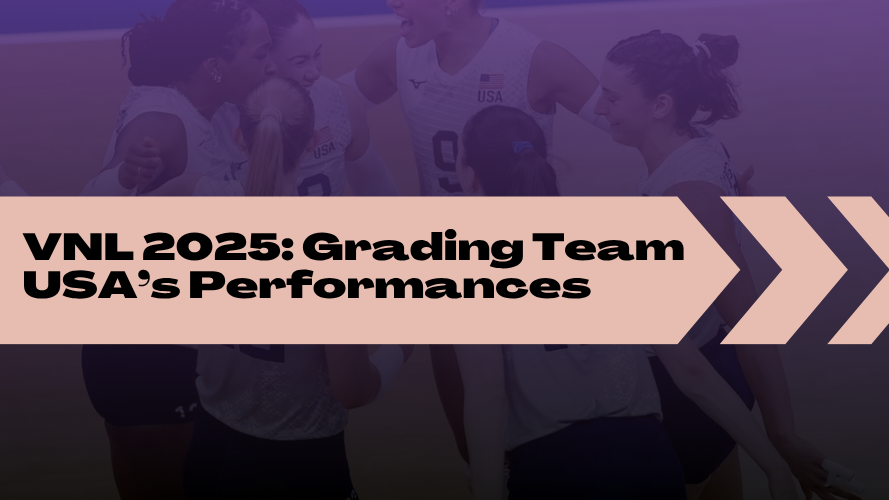
There were a lot of question marks for Team USA heading into this year’s Volleyball Nations League tournament, and most of them were not resolved by the end of the first week of competition. Now that we’re halfway through the VNL and have two weeks of matches to evaluate, it’s starting to become clear which players are capable of putting up game-changing performances and which players may be left off future rosters.
Based on the eight matches Team USA has played so far, I’ve assigned a grade to all of the players that I think it’s fair to judge at this point.
Note: While most of this is based on playing time—for example, judging Anna Dodson, Zoe Fleck, or Serena Gray based on the one match they played would be meaningless—I’m also applying a little bit of subjectivity in choosing not to evaluate Olivia Babcock. She has technically played in 17 sets, but only six of those were sets in which she was the starting opposite. Most of the remaining sets were those in which she came in as part of the double substitution with a setter and subsequently only played a handful of points. I personally don’t feel I’ve seen her at this level enough to give a meaningful evaluation of her performance.
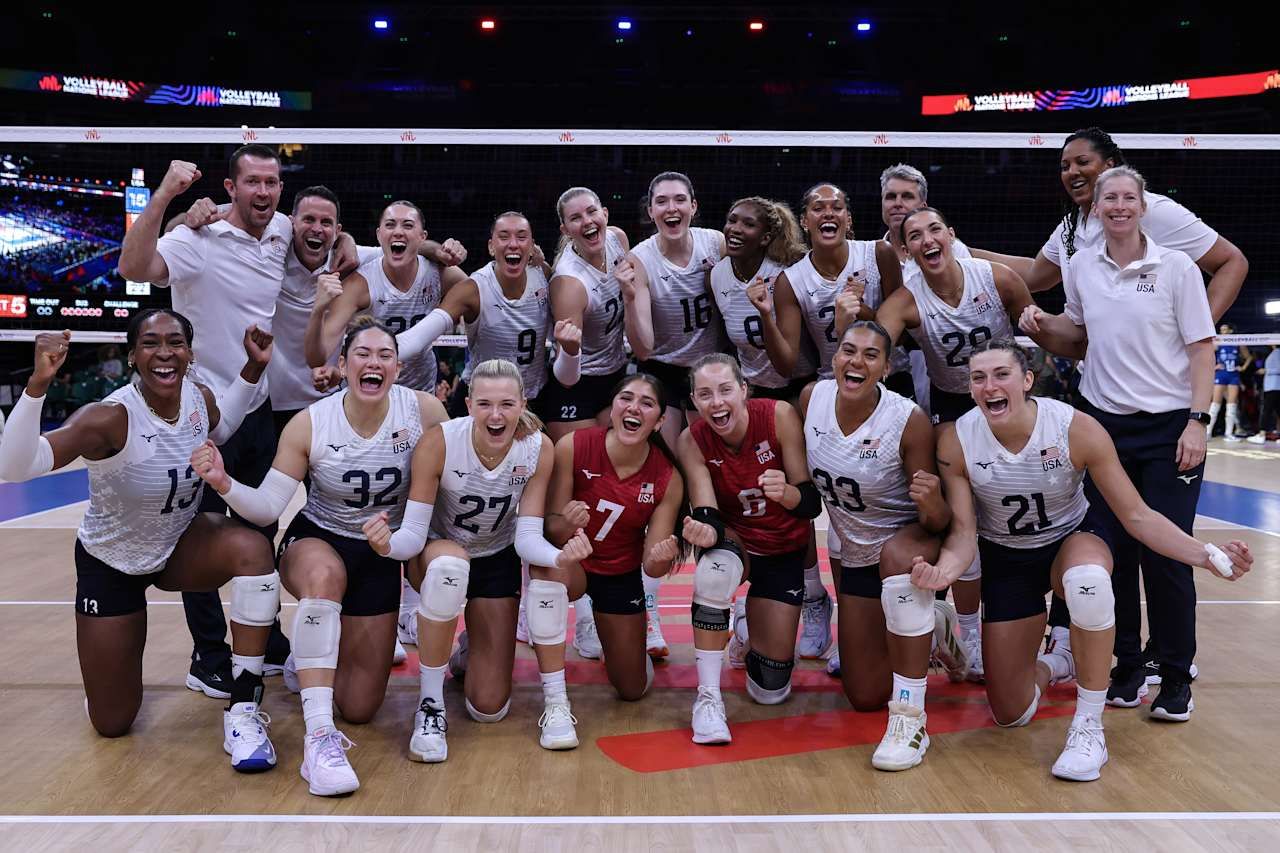
Outside Hitters
Sarah Franklin: A-
I have been impressed with Sarah Franklin–more so than I expected. Given that she has only one pro season under her belt, she has demonstrated grace under pressure and contributed significantly in terms of both offense and defense.
Highlights: While I wouldn’t say anyone on the team has been excellent from a reception perspective, Franklin has definitely been the best. She averages a 43% positive pass rate on 175 attempts, with standout performances against Czechia and Serbia. In terms of her attacking, she leads Team USA with 93 kills, and her hitting efficiency is just shy of .300.
Areas for Improvement: I’d like to see her bring a little bit more finesse with her shot selection and find high hands more often. Additionally, her service pressure is near non-existent. I’m optimistic that her upcoming season in Italy’s A1 league will help in these areas, particularly the shot selection.
Logan Eggleston: B
The first week of competition was pretty rough for Logan Eggleston, but she showed moments of brilliance that she has been able to carry much more consistently into the second week. Anyone who watched LOVB Austin this season has heard ad nauseam that Eggleston considers her ticket to the Olympic squad contingent on her passing. Based on her reception performance so far, that spot is certainly not guaranteed, but Eggleston’s athleticism and court vision have made her an exceptionally strong attacker.
Highlights: In week two,Eggleston has been extremely reliable as an attacker. Some of her kills during the matches against Poland made my jaw drop. Though she ended that match with “just” a .380 hitting efficiency, she was nearly unstoppable for the first set and a half and ended as the team’s leading scorer during the four-set loss, with 24 points. She was also extremely effective during the wins against Netherlands and France, notching 31 points between the two matches and hitting .480 and and .500 respectively.
Areas for Improvement: Eggleston’s passing, at least to my eye, wasn't as bad during the second week as the stats would suggest, but she still gets exploited in the passing lineup…a lot. She was aced 5 times during the match against Czechia and 4 times against Poland, and her average in-system pass percentage of 34% isn’t going to cut it. She was also fairly unremarkable during Week One from an attacking perspective. That said, her improvement during Week Two was extremely impressive. If she can get her reception under control and continue to grow as a hitter, her future is bright.
Roni Jones-Perry: D
I don’t enjoy being harsh, but unfortunately I have very little to add to the positive column for Roni Jones-Perry. Despite being named captain during the first two weeks, Jones-Perry hasn’t shown the skill nor mental resilience to justify the line under her jersey number—or even her spot on the roster.
Highlights: Her serve can be downright nasty for opposing teams to deal with, which explains her being utilized primarily as a serving sub during Week Two. She’s recorded three aces so far, with two of those coming in the straight-sets loss to Brazil.
Areas for Improvement: As a 6’0” (180cm) attacker, Jones-Perry is slightly undersized. It’s certainly possible to be an effective player at this height—let’s not forget that Brazilian superstar Gabi is only 5’11”—but it requires a level of court vision and physicality that I’ve yet to see from Jones-Perry. And her shortcomings from a defense and passing perspective leave me scratching my head as to what purpose she serves on this roster. Given that she’s 28 and still quite rough around the edges, I don’t see her having an extensive future with Team USA, so I’d like to see the staff invest in younger players with higher upside.
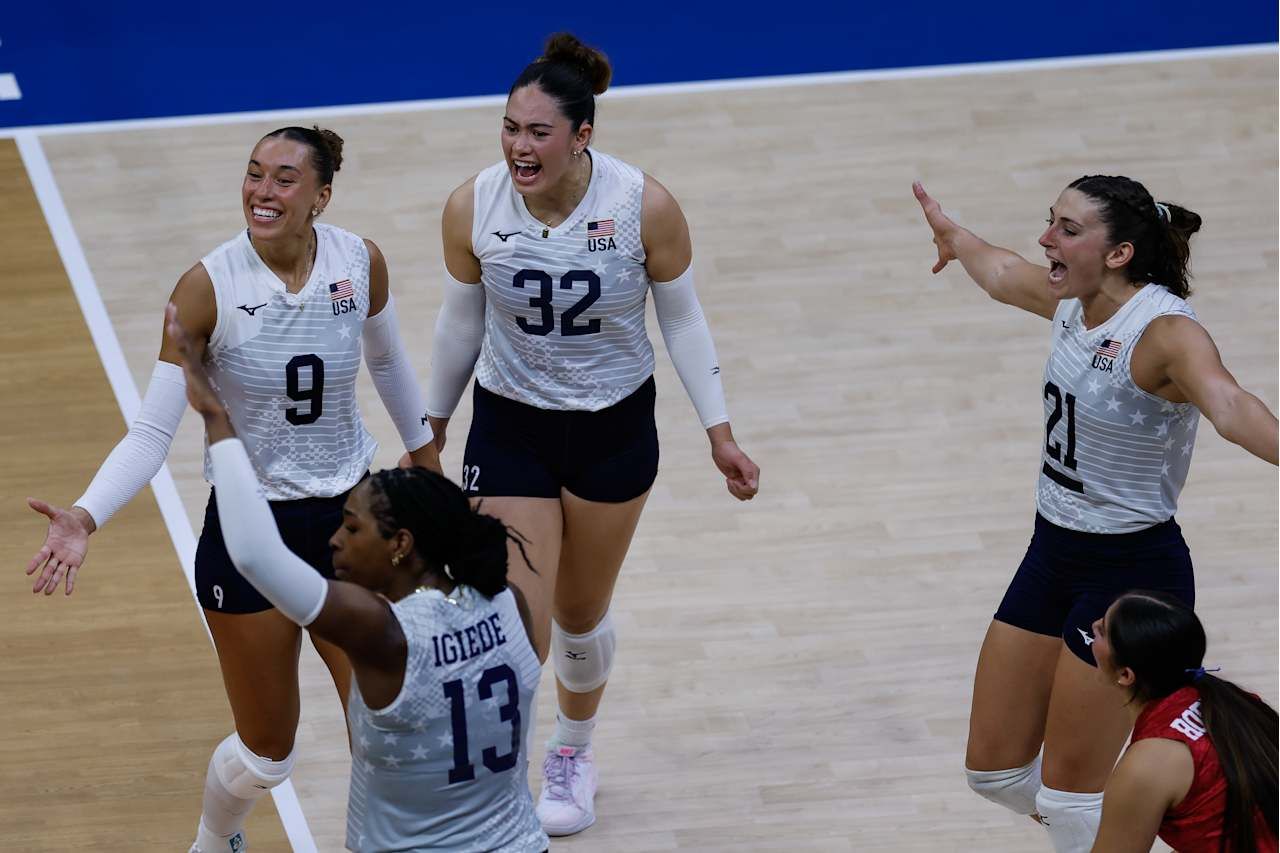
Opposite Hitters
Madisen Skinner: B+
Ranking Madisen Skinner’s VNL performance so far isn’t as straightforward as it is for others due to her being slotted in as a left-side attacker during the first week of competition. Thankfully, the coaching staff saw sense in Week Two and moved her over to the right side, where she is clearly much more comfortable. I’ll be evaluating her performances strictly as an opposite.
Highlights: That 32-point match against Serbia was a thing of beauty. It’s true that she wouldn’t have needed to get as many points if the team had taken care of business and swept Serbia, but the near-reverse sweep was no fault of Skinner’s. Her .350 hitting efficiency on the match doesn’t quite capture just how unstoppable she was at times, like during the third set when she registered 10 kills and zero errors on 14 swings. Her blocking has also been solid; she’s recorded six stuff blocks, and even when she isn’t ending the point, her block touches have helped slow attacks down and keep her team in the point.
Areas for Improvement: Staying consistent seems to be the biggest problem for Skinner. Her errors often come in bunches, which suggests that she’s getting too in her head at times. And though her bic attack is highly effective, she needs to diversify where she hits the ball, as opponents are catching on to its trajectory and getting better at blocking her as matches go on.
Logan Lednicky: C+
From an NCAA perspective, I am firmly all-aboard on the Logan Lednicky train and am looking forward to seeing how Texas A&M fares this upcoming season. At the VNL, however, her performance has been largely “meh.” This is to be expected given that she’s still in college, but I don’t know that I can definitively say that Lednicky can perform at this level. That’s not to say that she can’t in the future, though.
Highlights: That swing she took off of Rachel Fairbanks’ set in the match against the Netherlands? An absolute beauty. In general, she’s been a solid option for the double substitution (though I have my reservations about the use of the dub sub by Team USA, but that’s for another time). Her blocking has been pretty good too, with her recording five blocks so far.
Areas for Improvement: From what I’ve seen so far, Lednicky starts out effective and quickly stalls out as opponents adapt to her limited range of shots. Against Poland, for example, her hitting efficiency dropped from .330 in the first set, to .140 in the second, and then to a ghastly -.750 in the third. It is this pattern that has resulted in her overall hitting numbers being shrug-worthy at best. She also shows weaknesses in defense and especially in her cupcake of a serve. I’ll be interested to see how she develops after her NCAA career is over, as I still think she’s worth investment by Team USA.
Looking for Olivia Babcock? See the intro for why I'm omitting her.
Setters
Ella May Powell: F
Again, it brings me no joy to rate any of these players poorly, but Ella May Powell was entirely disappointing. After being the setter in the two straight-sets losses to Italy and Brazil, I was quite confused as to why she was added to the Week Two roster. The only explanation is the rumors of injuries to fellow setters Jordyn Poulter and Jenna Gray.
Highlights: Um… I’m sure she has a great personality.
Areas for Improvement: Powell was mystifyingly slow to get under the ball whenever it was sent anywhere other than right over her head to the point that it was almost comical. Even Poulter was faster than her last summer, despite having just healed from a gnarly knee injury and sporting a giant brace. Beyond that, her setting location was highly inconsistent and generally poor, and she had a tendency to bump set balls that she absolutely could and should have taken with her hands. Her defense and blocking also left a lot to be desired.
Saige Ka’aha’aina-Torres: A-
I wasn’t convinced by Saige Ka’aha’aina-Torres during her season in LOVB or her Week One performance, but the offense she ran during Week Two was, simply put, exceptional. I’ve been high on Rachel Fairbanks and Kami Miner as the next generation of USA setters, but I’m ready to add SKT to that list if she can keep up the kind of performance we saw this week.
Highlights: Virtually the entirety of Week Two was one giant highlight for SKT. She maintained a balanced offense while still locating the hot hand when needed, and was able to isolate hitters against a non-existent block several times. I was especially impressed with her ability to run Dana Rettke on the slide as well as her commitment to repeating that set when the first attempt didn’t land. She also proved to be Team USA’s strongest server, notching four aces so far.
Areas for Improvement: SKT’s right-back defense could use work, as that was an area that I saw get exploited frequently. During Week One she set some unhittable balls, particularly to Sarah Franklin, but she seemed to have cleaned that up during the second week. I’d also like to see her be a bit more offensively-minded herself in order to keep the opposing block on its toes.
Middle Blockers
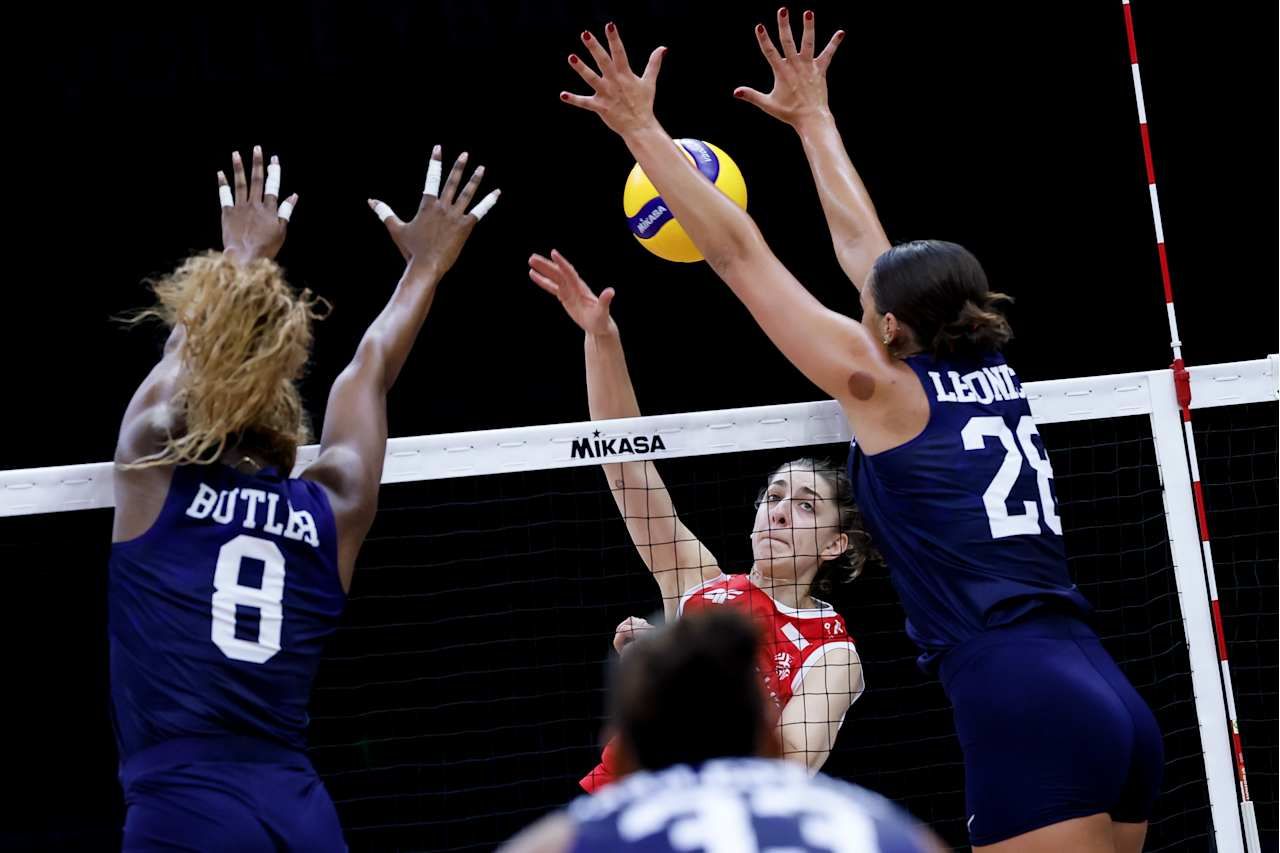
Brionne Butler: B+
As expected of a player who has several pro seasons and VNL tournaments under her belt, Butler brought some elite blocking and leadership with her to Belgrade.
Highlights: Butler came out strong in her 2025 debut, notching six blocks and two aces against Poland. If block assists were recorded internationally, she’d undoubtedly have plenty of those two, as opposing hitters were set on avoiding her whenever possible. She also made some smart shots, such as a sneaky two-handed push to the back of the court against France.
Areas for Improvement: For a middle, Butler’s efficiency on the week could be a bit higher. She only hit .170 against Poland thanks to erroring three times and not always hitting the ball at full strength, but she figured it out against France, where she hit .710. Additionally, I don’t think she should be hitting slides—she’s much stronger and seems a lot more comfortable hitting in front of the setter.
Dana Rettke: A-
Unsurprisingly, Olympic silver medalist and multi-year pro Dana Rettke helped boost Team USA’s performance significantly in Week Two. Her blocking was solid, but where she really shone was offense.
Highlights: Rettke’s slide attack is deadly when she’s paired with the right setter. In the previous quad, sets to her weren’t always on the money, but SKT knew exactly how and where to get Rettke the ball for success. She hit .480 on the week, with a high of .560 on 11 kills against the Netherlands.
Areas for Improvement: I’m not sure what happened to Rettke’s serve since it can typically be highly effective, but she served into the net a lot this week.
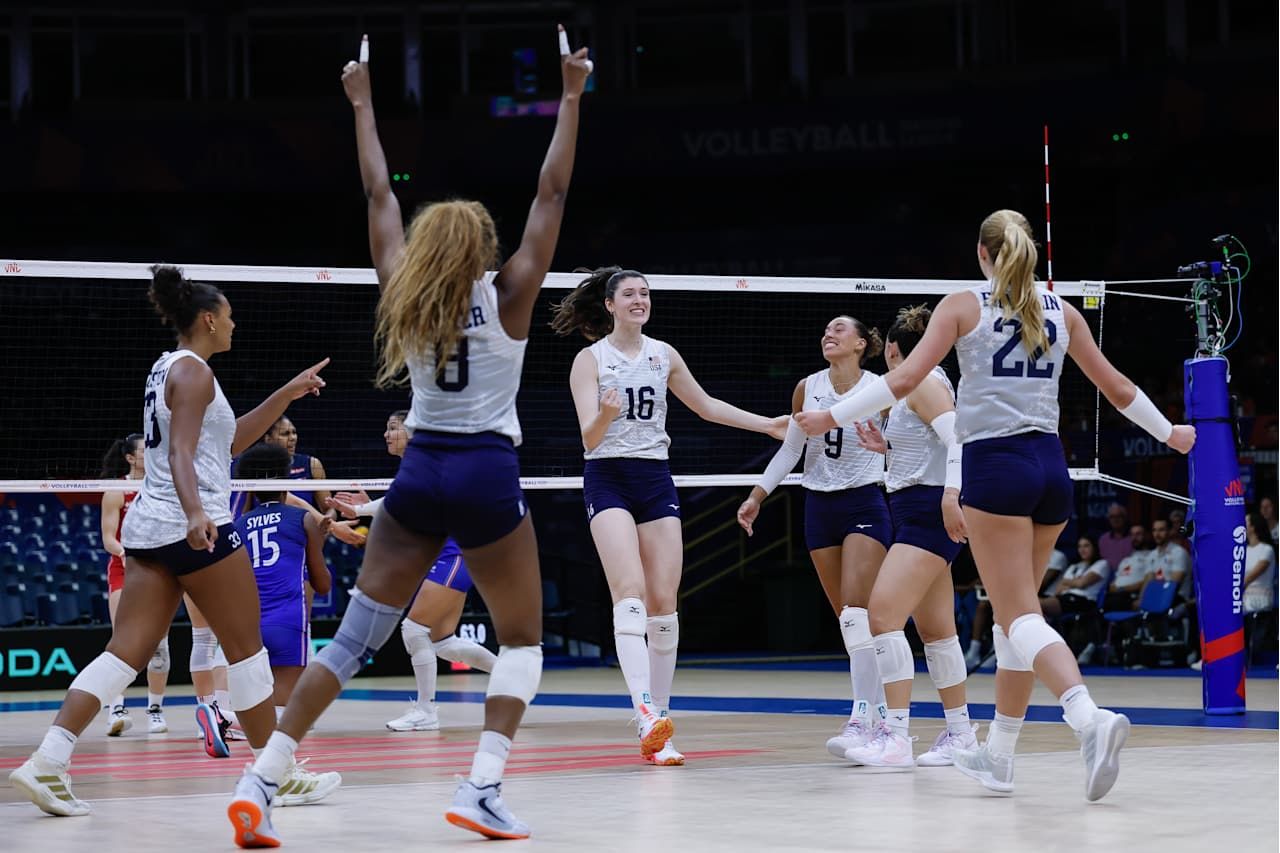
Molly McCage: B
I was surprised upon reviewing McCage’s stats, because based on my recollection of her performance, I found her mostly unremarkable aside from a few nice blocks in Week One. She’s been steady enough, however, but her future with the national team is a question mark in my head given that she’s 31 and this is her first time playing with the senior team.
Highlights: She played best during Week One, during which she got some blocks on both Italian opposites in addition to five blocks during the Czechia match. After four matches, she has 13 blocks and a hitting efficiency of .320 on 15 kills.
Areas for Improvement: Like Rettke, McCage’s serving was unreliable, most notably against Poland when she errored three times from the line. Her offensive output has been fine, but could be improved. It’s hard to judge, though, given that she mostly played during Week One, when USA’s passing was at its worst.
Amber Igiede: B
Igiede may be Team USA’s leading blocker after these first two weeks, but I’m not convinced that her blocking is actually up to the standard it should be—more on that in a moment. Attacking is where she shines, though she also hasn’t been fully consistent from an offensive standpoint throughout the competition so far.
Highlights: Nine blocks in a sweep is nasty work, and she hit .700 in that same match (against Korea) to boot. She was also one of the bright spots coming out of the devastating loss against Czechia, against whom she hit .550 with 13 kills and had four blocks.
Areas for Improvement: Nine blocks in a sweep against Korea is a whole lot different than if it were against a better, taller team. Aside from that performance, Igiede was averaging half a block per set, which isn’t ideal. Her hitting also could be more consistent, as she had several matches hitting under .300. That said, there were a few matches that she was inserted for a set and a half at most, so it’s hard to judge her fairly based off of those.
Liberos
Morgan Hentz: B
Given that she was the alternate libero for the Paris Olympics and a solid performer at past VNLs, it’s difficult not to hold Morgan Hentz to a high standard. And, in my view, she just didn’t meet those standards. She hasn’t been awful by any means, and she’s made some plays that I don’t think anyone else could, but I’m not convinced she’s the obvious successor to Justine Wong-Orantes.
Highlights: Some of her saves against Poland were absolutely insane, particularly one where she dove to send a ball back over the net from a tough angle to get it inside the antenna. Something that has made Hentz so popular in volleyball spaces online is that never-ending determination to get to the ball, making her quite a flashy player to watch.
Areas for Improvement: Her out-of-system setting leaves a lot to be desired, as she regularly set way too close to the net. And for a libero, whose passing should be the most reliable on the teams, hers just isn’t. Against the two top teams she played against—Italy and Poland—she passed in-system at a 29% and 20% clip respectively, which is simply not good enough.
Lexi Rodriguez: B+
For a newcomer to the VNL, I thought Lexi Rodriguez did a solid job. There were some passing inconsistencies and digs that she probably should have made that she didn’t, but I’m willing to be a bit more lenient with her given her inexperience.
Highlights: In her first VNL match, she passed 56% positive and had 17 digs. It’s tough to criticize that statline for a senior team debut. Additionally, while the VNL doesn’t record assists, I thought her out-of-system setting was far better than Hentz’s was.
Areas for Improvement: As is typical of athletes playing alongside each other for the first time, there’s some communication that needs to be established between Rodriguez and the others in the passing lineup. I saw a few times where Franklin poached serves from Rodriguez when it should be the other way around, and the seams between them were exploited by opponents.